

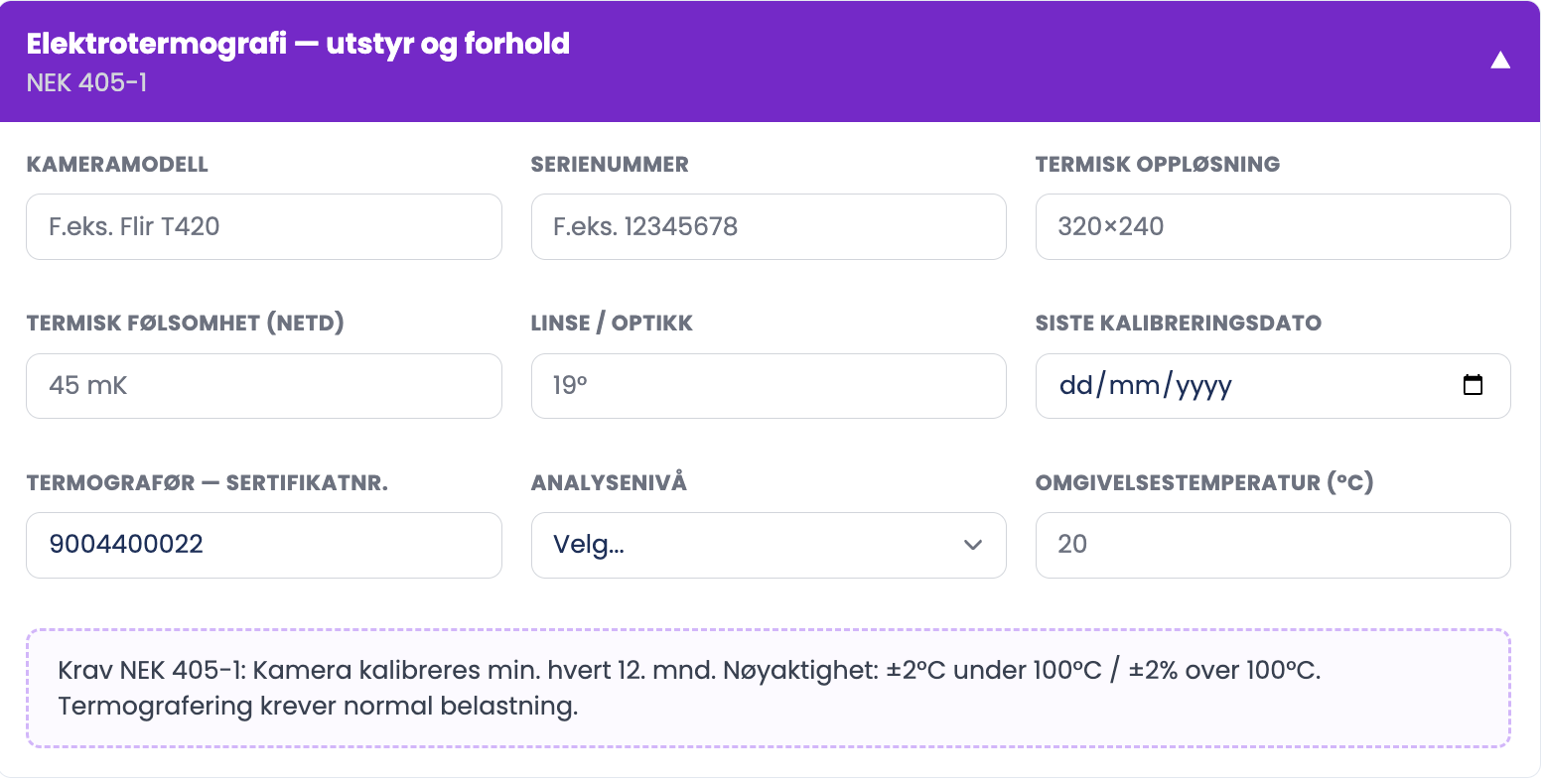
This section documents the camera and the conditions during the thermography. Without it, the thermography findings cannot be verified. The fields are filled in once and apply to the whole inspection.
The fields
- Camera model, serial number, thermal resolution, thermal sensitivity (NETD) and lens / optics.
- Last calibration date.
- Thermographer — certification no.
- Analysis level: Level B low voltage or Level A (spot check).
- Ambient temperature in degrees Celsius at the time of the inspection.
The camera must be calibrated at least every 12 months. Accuracy ±2 °C below 100 °C and ±2 % above 100 °C. Thermography must be carried out under normal load.
Where the temperatures go
- The temperature values do not belong in this section. They are recorded under Measurements, with + Register thermography.
- There you fill in Max temp, Reference temp, ΔT in degrees Celsius and Load in per cent, and you can attach an image.
- If you are doing a full set of measurements at the same location, use + Register measurement instead. It has its own Max temp field.
- Point A Temperature under load says so in its own help text: temperature values go in the Measurements section.
Good to know
- Three inspection points are marked THERMOGRAPHY: A Temperature under load, K Overheating in sockets, junction boxes, outlets, plugs etc., and Q Solar installations.
- The calibration date is not a formality. If the camera is out of calibration, the measurements cannot be documented, and the findings may be rejected.
- The ambient temperature is the reference when temperature differences are assessed. It belongs to the moment of inspection, not to the daily average.
- The certificate number is not filled in automatically here. The field Thermographer — certification no. sits in this section and is entered manually.
Tips
- Enter the camera details early. They apply to the whole inspection, and they are easy to forget once you are into the points.
- Copy the calibration date from the certificate, not from memory.
- If you inspect an installation running at low or no load, the findings cannot be used for grading. Agree with the owner that the home is in normal use when you arrive.
- Fill in Load as a percentage. Without it, ΔT says little.
Do I have to use a thermal camera in every home?
Points A, K and Q are marked THERMOGRAPHY because they concern overheating, and overheating cannot be judged by eye. A thermal camera is the tool that makes the assessment verifiable. If you cannot use one, the report must state what you based the assessment on instead.
Camera details come from your profile
Camera model, serial number, resolution and calibration date are taken from your profile.